Tuesday, May 25, 2010

The End of People Moving? Follow the Grad Students

An original article written for #hackacad

I'll be presenting in Montréal later this week, from the comfort of my Vancouver home, 3 500km away. It may seem like something out of a 1950s commercial for picture-phones, but as we all know, it's really not that complicated anymore. In this case, all I need is a webcam and an Internet connection.

As soon as I've finished this article, I'll don my dinner jacket and ascot, sit by the fire in a wingback chair and record a video of myself speaking with a fake British accent. I'll then post it online where my graduate student colleague in Montréal can access it and show it in a week's time at the conference. As he is co-leading the project with me, I trust he will have no trouble answering any questions the audience members may have about our work.

Distance travelled: 0km
Total Distance not travelled: ~7000km
Total cost: $0


The work I'll be discussing is a virtual network of scholars I helped establish this past year for graduate students looking to reach audiences beyond the academy. Every five months we put out an internal call for participation that asks members to draft an idea to submit to an editor. We then meet to offer encouragement and feedback on the drafts.

Please note that by “meet” I mean none of us leave the comfort of our homes. We leverage the power of a Google Group and email to bring together graduate students from 17 different Canadian institutions of higher learning. After our first call for participation, our members had a 75% publication success rate - far higher than the 10% return most new freelance writers can expect.

Distance travelled: 0km
Total distance not travelled: ~22 000km
Total cost: $0


On Monday, I have a meeting with colleagues in Ottawa, Edmonton, Toronto, Saskatoon and Tokyo. We've decided to forego the collective 17 000km it would take to bring us all together, and instead we'll be meeting via Skype.

Distance travelled: 0km
Total distance not travelled: ~ 39 000km
Total Cost: $0


It's a good thing we're getting used to Skype, because we're meeting to discuss a virtual workshop we're hosting in October that will bring together 20 graduate students from around the world. The event will be held online using Skype, Flickr, YouTube, Wordpress and email. Students who would never have otherwise had an opportunity to meet in person will be able to do so without having to leave town. We've never done anything like this before, so there's a bit of that will anyone come to my party feeling, but I'm happy to report that with several weeks to go until the deadline we've already received applications from over a dozen students in four countries on three continents.

Distance travelled: 0km
Total distance not travelled: ~ 95 000km
Total cost: $400 (we're issuing headsets to all participants to ensure our cross-continental workshop has good sound quality).


The idea for the workshop came from a Canadian virtual reading group that graduate students have been running of their own initiative since September. Students from across Canada meet once a month - you should be catching on to the meeting venues by now - to critique dissertation chapters and draft articles. The tools of their trade are Skype, email and Google Groups. With them, these students have developed a long-lasting collegial rapport with one another, which no one-time event could achieve.

Distance travelled: 0km
Total distance not travelled: ~ 145 000km
Total cost: $400


The Canadian Historical Association's (CHA) annual meeting is being held next week in Montréal. This is the biggest annual historical conference in Canada with thousands of people attending to witness approximately 400 scholars present papers.


I've been trying to find an interested graduate student who plans to attend the conference, and who could audio record presentations that would then appear online. This would allow people who were unable to travel to Montréal to access the information that was shared at the conference. Unfortunately, so far every response I've received is, “sorry, I'm only going to my own session and then going home.”

Distance travelled: ~1000km / participant * 1000 = 1 000 000km?
Total distance not travelled: ~ 145 000km
Total cost: $Millions


Maybe it's time we followed the lead of these graduate student initiatives and started moving information, not people.

Adam Crymble lives in Vancouver where he works for a national network of researchers. His boss lives 3 368 km away.

Tuesday, May 11, 2010

Online Versus Face-Time

Library and Archives Canada (LAC) is cutting an on-site World War I workshop intended for high school history classes, and took some heat in the Globe and Mail for the decision (the article, "First World War workshops soon to be history" [Feb. 25, 2010] is behind a pay wall).

The workshops offered Ottawa-area students the opportunity to handle World War I era letters from soldiers and learn about the soldiers' experiences from LAC archivists who had expert knowledge of the material.

The article paints Canada's national archives as near-sighted for replacing face-time between students and expert archivists with online PDFs and lesson plans for teachers.

Nothing could be further from the truth, and Canadians should be applauding the decision. In the face of a huge Canadian deficit this year, it is important for cultural institutions to justify their spending and look for more efficient ways to offer Canadians their services. LAC has achieved this by placing the learning resources online, making them available to far more students, and reassigning the staff who offered the workshops to other tasks.

Critics argue that it's not the same for students to read online PDFs as it is to hold the actual letters written by soldiers, and that the expertise of the archivists adds to the learning experience. I certainly cannot argue that these cuts are not a loss for Ottawa-area students and teachers. But, claims made in the article that teachers - who are not WWI experts - cannot teach the content or that students will be unable to make the connection between the short-hand, “GSW” and “gunshot wound” are overly apocalyptic.

Our educational curriculums are designed to teach our students skills that are realistic and are based on their maturity and prior education. To suggest that Canadian high school teachers are unable to teach those skills without the help of an archivist is a disservice to the countless excellent teachers out there - many of whom have no option but to create their own lesson plans.

If a teacher is concerned that the students will not have the same experience with a PDF as they would with the actual letters, I invite them to use some creativity: print off the letters and Google “how to make paper look old.” All you need is some coffee and a little bit of planning. Not sure what a “GSW” is? Read the tool kit that accompanies the project, or email an archivist for clarification.

This shift from on-site to on-line content will create a program that students and teachers from Vancouver to St. John's to Yellowknife can use in their classrooms. Unlike smaller countries like Italy or Germany, Canadians are not connected via high-speed rail lines or short bus trips. Even if financial restraints were not a concern, it would be environmentally irresponsible to fly all Canadian students to Ottawa to participate in these workshops. Paying to set up workshops across the country is equally unrealistic.

Instead, to keep our education system competitive, we have to ensure our virtual connections can bridge the vast distances our geography demands and offer all students access to important educational resources.

The solution is not to offer more local programming, but more national programming that is created once and remains useful for many years. Instead of asking Canadians to continue to pay for each workshop, LAC has decided to ask Canadians to pay once more for archivists to scan and upload the documents and make them available for years to come at no further financial burden.

The change may not be the best for everyone, but it's better for most Canadians. Face- time is great, but we must also be prudent and accountable to all Canadians for the money we put into services accessible to only a few. For that, I applaud LAC for their forward thinking as we continue to make our educational system more sustainable, from coast to coast.

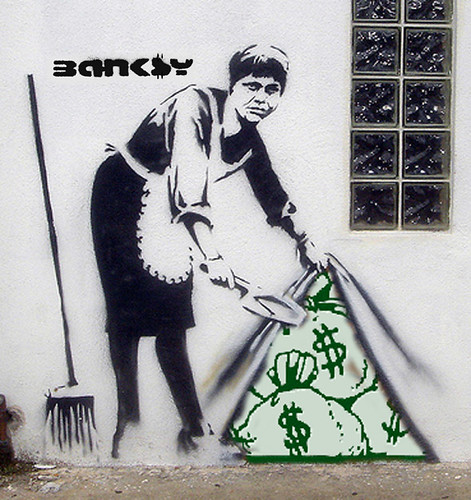
Photo Credit: "Takin' it to the BANK$Y" by John.

Tuesday, March 9, 2010

New Article: "Beyond the Peer Review"

Looking to ensure your research gets exposure? Take a look at my article "Beyond the Peer Review" in this month's University Affairs Magazine.

You might also be interested in learning more about the "Reaching a Popular Audience" Workshop I'm involved with later this month.

Disseminate or disappear.

Monday, January 18, 2010

Reaching a Popular Audience Workshop: Vancouver 2010

Application Deadline: Feb. 15, 2010
Event: Mar. 26, 2010

Apply Now


Fifty thousand screaming readers rush the newsstand to get a copy of your latest research. Okay, maybe they're not screaming, but the numbers probably aren't that far off. While peer-reviewed journals may make the academic world go round, it's through magazines and newspapers that your work can make its way into homes across the country – and you might be surprised to find out how interested Canadians are in what you do.

The Network in Canadian History & Environment (NiCHE) is sponsoring a one-day graduate student workshop on Friday, March 26, 2010 at the University of British Columbia in Vancouver. The workshop will teach participants how to propose a suitable article for a popular publication and effectively pitch it to a relevant editor.

The application deadline is February 15, 2010. Applications can be made using the online application form. Accommodation grants are available for out-of-town participants. A limited number of participants living outside the BC Lower Mainland and Vancouver Island may be eligible for travel grants.* Anyone who is registered or intends to register as a graduate student at a Canadian university in 2010 can apply, though some places are reserved for students studying environmental history or historical geography. Space is limited.

Participants can opt to receive continued support by joining the Active History Writer's Guild, a free organization which encourages and mentors young academics looking to propel their ideas into the public eye.


Generous Support Provided By:
The Network in Canadian History & Environment and the University of British Columbia.

* NiCHE has provided funding to fly in and accommodate up to two students living in Northern B.C., Alta., or Sask. who are current NiCHE members.

Photo Credit: "1959 Voss Deluxe" by Oliver Hammond.

Tuesday, January 5, 2010

Active History: Live Blogging History

For those looking for new ways to engage the public with history and the internet, check out my article on Active History that looks at the idea of posting historical events to a blog over the same span of time that the event took to unfold.

Live Blogging History: Accessible and Creative

Sunday, November 29, 2009

Google Anti-Spam Policy Hurts Poor / Disabled Most

Google has decided to fight against spam emails by making it much more difficult to sign up for a Gmail account. The idea they came up with was to require a person signing up for an email to give a cell-phone number with texting capabilities. Google would then text you a password which you can use to activate your account. This allows Google to make it much more difficult for automated systems to set up accounts and by limiting the number of accounts per cell-phone number spammers will have trouble staying in business. A rather ingenious solution, but one designed with the western world in mind.

For me - a non-cell phone user - it's annoying. The solution recommended by Google is to ask a friend if I can have the password sent to their phone. I don't want to do it, but if I need to I can get around the problem. After all, I can't complain too loudly considering Gmail is free and offers invaluable services to users.

But, what about those millions of people who do not own cell phones or do not have friends with cell phones either? There are thousands of people whose only access to the internet is on shared computers in public libraries, community centers and job-bank agencies who could benefit immensely from free email service as they search for jobs or to connect with friends and family.

What about people in third-world countries who may have access to a community computer, but may never have seen a cell phone with texting capabilities? One of the greatest things about the internet has been the ability for people from all walks of life all over the world to access information and services that had previously only been available to the rich.

What about my blind grandfather, who is an avid computer user, but obviously has no use for texting? I hate to stereotype, but I'm pretty sure if he were to ask his friends at the retirement home, he'd be hard-pressed to find anyone texting their grandchildren who he could ask for help from to get onto Gmail.

I can appreciate Google wants to cut down on spam and that people in third world countries, on government assistance or the blind probably don't bring in as much revenue as your average upper/middle class Google user, but the whole policy strikes me as anti-social and poorly thought out. Gmail was an opportunity for those unable to pay for expensive services such as cell phone plans. And it's an opportunity that's being denied them by a company that so often takes the lead in making information and services available to the world.

I'll be keeping my eye on this policy and I hope to see changes soon:

You can see the "Help" page to see for yourself just how inaccessible this policy is.

Wednesday, November 18, 2009

How to Write a Zotero Translator - Print on Demand

After a suggestion from Tom Scheinfeldt at foundhistory.org, I've decided to release my open-content monograph, "How to Write a Zotero Translator" as a print on demand book for those who prefer a paper version. The book was originally released as an open-content website by the Network in Canadian History & Environment and is still available on their website.

As Dr. Scheinfeldt rightly pointed out, sometimes it's nice to have a tangible copy that doesn't compete for screen space with your coding work. The book is available for $11.99 through Lulu.com.

The content of the print on demand is the same as what's available on the website, so it's up to you to decide which you prefer.

I'm happy to report that several people in a broad range of countries have used the guide to create translators, including some for foreign language sites. If you have used the guide to help you create a translator, please let me know!

To acquire "How to Write a Zotero Translator" visit the product order form on Lulu.com.