Thursday, February 3, 2011

New Omeka Theme Released

For those Omeka users out there, you've now got one more free design option for your site. I have recently released my theme, "Easy Colour", freely available on the Omeka website.

For those without website design experience, a free theme can save you thousands of dollars. The one I have created is designed to make it easy for users to customize the colour palatte to suit their own tastes or institutional colours.

I hope you find it useful!

Tuesday, January 25, 2011

Distant Reading by Using a Written Index

Today, gauging the general pulse of what people are saying or talking about or reading is fairly easy. Twitter's "Trending Topics" are one of many methods for seeing what people are interested in right now. Others include a scan of the top stories in today's newspapers, or a comparison of today's blog posts by keyword.

But how do we gauge that same pulse historically? What were people interested in 200 years ago? Can we really know?

One method is to look at what people read. For example, in 18th century London, the Gentleman's Magazine was the most successful magazine that targetted a wealthy and powerful audience. The Gentleman's Magazine published for over 200 years, starting in 1731 and during the late eighteenth century was England's most respectable magazine. In the first issue, the editor declared the magazine was originally conceived to "give monthly a view of all the pieces of wit, humour, or intellligence, daily ofered to the Public in the Newspapers, (which of late are so multiplied, as to render it impossible, unless a man makes it a business, to consult them all)".

Since we know that the magazine sold well, it's fair to assume that the editors were providing content that people wanted to read and is therefore a relevant measure of what people found interesting, broadly construed. That's not to say everyone who read it thought every article spoke to their soul. It's just to suggest that people vote with their wallets and one of the strongest indicators of a publication's influence is the number of copies it sells and for how long its able to continue publishing.

This magazine has since been digitized by Google Books, but to my knowledge, there is no accessible machine-readable text version freely available. However, there is a paper subject index of all the essays written for the magazine. The index was compiled in 1821 by some poor chap whose father insisted upon the task. The index won't give you the same full-text search option we've come to love in search engines. It is organized thematically into categories selected by the indexer. This means there is a fair degree of bias in terms of what was categorized, how it was categorized, and what was overlooked. However, with 675 pages of topics, along with the various page references to find the article, the index itself provides a useful gauge of what was appearing in the magazine during the 30 year period covered by the index (1787-1818).

reading John Bull's mindEach page is split into two columns. Using the columns as a unit of measure, I have compiled a list of the 34 most prevalent subjects from the Index and graphed them as a word cloud. France had the most 11.5 columns of entries and Africa had the least with half a column. Given the status of the magazine with Britain's upper classes, and given the fact that the magazine was successful, and therefore publishing content its readers wanted to consume, I believe it is fair to say that this word cloud is a fairly good - yet rough - illustration of what was important to wealthy Englishmen from 1787 to 1818.

Given the international affairs between Britain and various countries of the world during this era, the countries that appear most prominently are perhaps not a surprise. However, there are a few observations that I think are worth noting. Overall, I would suggest this wordcloud shows us what the wealthy people of late eighteenth, early nineteenth century England were worried about. Without reading the articles, or even knowing what the titles of the articles are, it would seem that these "Gentlemen" were writing essays about countries with which England was at war or at odds: France, Ireland, America. Less frequently appearing are Scotland and Wales, both passive at this point in terms of relations with England, along with Switzerland who tended to stay out of things.

The third most common term is "Naval Action" and "Buonaparte" is high on the list. Fires (7 columns), Storms and Murder all appear on the list. The first two threaten commerce, and murder is an obvious concern. Cowpox (which had been discovered could be used to vaccinate against Smallpox) is as prominent as Scotland or England. However, notice theft, rents, or poverty don't appear at all.

By applying my historical knowledge of Britain during this era, my distant reading of the Gentleman's Magazine suggests to me the following conclusions:

Wealthy Englishmen in the late eighteenth, early nineteenth century were interested in whichever country was currently causing the most trouble. They wanted to be kept informed of things that could kill them, or things that could disrupt their trade. They were interested in discussing the structure of the Anglican church, but less interested in discussing other religions, or directly engaging with the Bible. And finally, London was more important than America.

Is this perfectly accurate? No, of course not. But it is a macro-analysis of the interests of wealthy male Englishmen from 1787 to 1818. And it only took 20 minutes.

I would be interested to hear from others who are engaged in distant reading, or comments and concerns you may have about my methodology and conclusions, from digital humanists and historians alike.

Monday, January 3, 2011

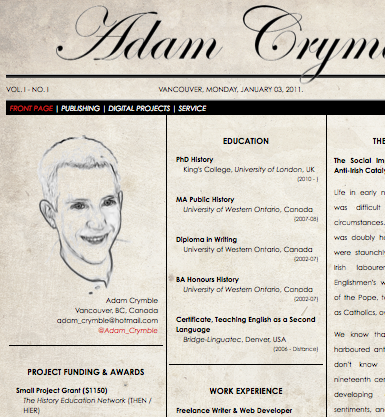
My C.V. is Better Than Yours

Sure, you may have more publications, conference presentations and funding. You may have a better job than I do or more awards. The contents of your C.V. may make mine seem underwhelming.


But my C.V. is better. In fact, I’m confident that if we applied for the same competition, it would be my C.V. that had the committee members talking over lunch. “Did you see that guy’s C.V.?”


My C.V. makes noise. It moves by itself. It’s shiny.


See why My C.V. is better than yours: My C.V.


I’ve taken up the challenge of Dr. Tom Scheinfeldt in his blog post “New Wine in Old Skins: Why the CV needs hacking”. In that post, Scheinfeldt urged academics to come up with new ways of presenting their achievements. Ways that moved beyond the traditional lists that have largely remained unchanged since the eighteenth century.


So I'd like to extend a challenge, particularly to the digital humanists out there. Let 2011 be the year you make your C.V. better than mine. And let me know about it.

Saturday, November 20, 2010

Do People Want Open Access to Research?

If you post a peer reviewed article on your blog, will anyone care?

Apparently, emphatically yes.

In an experiment earlier this week I decided to post my recent article about Social Media use by Archives and Archivists (see my previous entry) and made a quick announcement on Twitter. The response was far greater than I expected, with over 700 people in just a few days taking the time to visit and read the abstract or access the PDF and I received messages from several archivists thanking me for sharing the article.

As you can see from the graph of my recent traffic on this oft-neglected site, the results weren't typical.

So what does this mean? Well I think we can infer a few things from this.

Firstly, that people want to read research. Secondly, if authors retain copyright of their work, that access becomes possible.

The only reason I was able to - legally - offer this article to readers was because of Archivaria's very forward-thinking rights assignment policy in which I retain the copyright for the work but grant Archivaria all the rights they need to publish as many copies as they like in as many forms as they like. In return, I have been asked to always provide a full citation whenever I reproduce the article to acknowledge the work of Archivaria.

As an author, this rights assignment policy was the most influential single factor I took into consideration when choosing a journal in which to publish. In this case I overlooked larger journals who demand authors assign full rights, because I believe the whole point of me doing research is to share the results.

Arbitrarily assigning all rights doesn't achieve that goal if the article then sits behind a paywall that may or may not be heavily subscribed.

So what can we do to promote this open-access attitude?

I think the first thing is to start telling editors that you want it.

For writers:
  • Email editors before you submit and tell them you have an article idea but you are a supporter of open access and you would like to know the journal's policy.
  • Protect your copyright. Negotiate your copyright assignment so that both the editor and you can benefit. There is absolutely no need for you to give away your copyright. And if you are going to give it away, insist that everyone has access: license it under Creative Commons.
For readers:
  • Let editors of publications know that you want to cite material in their publications but you do not have access and will have to overlook their contributions.
  • Let authors know you would like to cite material they wrote but you do not have access and will have to overlook their contributions.
  • Thank editors who have formulated forward-thinking copyright policies that promote open access to research.
On that last note, I'd encourage anyone who accessed my article over the past week to contact Archivaria (Contact Info) and let them know that you appreciated being able to read their material. Sometimes a little thank you goes a long way to driving change.

Tuesday, November 16, 2010

An Analysis of Twitter and Facebook Use by the Archival Community

I have recently published an article in Archivaria, the journal of the Association of Canadian Archivists (ACA) that looks at how Archives around the English-speaking world have used Facebook and Twitter as a form of social outreach.

I hope this work will be of interest to those outside the archival community and amongst those who may not have access to Archivaria, so I have decided to share a copy freely in PDF format.

Crymble, Adam. "An Analysis of Twitter and Facebook Use by the Archival Community" Archivaria 70 (Fall 2010): 125-151 [PDF]


Abstract
: This paper discusses how the archival community is using social networking services such as Twitter and Facebook as outreach tools. The study analyzes the usage patterns of 195 individual and institutional users over a thirty- two-day period during the summer of 2009. By focusing on the 2,926 outbound links posted to the services during the period, the author shows that use is dramatically different between the three test groups: archival organizations using Facebook, archival organizations using Twitter, and archivists using Twitter. The study shows that archival organizations overwhelmingly use the services to promote content they have created themselves, whereas archivists promote information they find useful. In all cases, more frequent posting did not correlate to a larger audience. By examining how others have applied social networking, archivists and archival organizations can determine a social media outreach platform that is suitable to their institutional needs. This study may serve as a starting point toward a greater understanding of outreach in the digital age.

Sunday, November 7, 2010

An Easy, Effective Event Homepage for Your Academic Event

Last year I wrote a blog post about How to Archive a Conference. Since then, I've been hired by several academics to build conference websites. Now, I'm pleased to offer a simpler, more affordable solution : Academic-news.org.

From upcoming conferences to past workshops. Academic News is your affordable, stable, simple solution - no website experience necessary. Be up and running in minutes.

Web designers are expensive: $40 to $100+ per hour. And building a website isn't just a matter of cutting and pasting. Design takes time, and that adds up. A small website with just a few simple pages can cost well over $1000.

Academic News recognizes your funding is precious. So I've developed an alternative: a one page Event Homepage hosted on the Academic News website, configured to effectively showcase your event - no web designing experience necessary.

All webpages share the clean, professional look and feel of the Academic News website. The easy to use form lets you customize your page by adding text and images. There's even space (20MB) to upload readings, schedules, maps, forms and more.

Focus on what matters. Leave the website to Academic News.

Use the site to attract potential participants, or as a deliverable to funding bodies.

You’ll get:


  • A professional looking, easy to edit webpage

  • Configured specifically for academic events

  • A customizable web address (URL)

  • 20MB storage for PDFs (schedules, maps, readings, etc)

  • Email support

  • Maintainance of copyright ownership

  • 5 year guarantee


All for a simple one-time fee – no subscriptions, no hidden costs. Do-it-yourself or full services packages available.

View a Sample Homepage


Reaching a Popular Audience - Vancouver 2010

Have questions? Check out the FAQ or Contact me at admin@academic-news.org .

Wednesday, August 4, 2010

How to Write a Zotero Translator: Wikified

I'm pleased to announce that the book I wrote a little over a year ago: How to Write a Zotero Translator (2009) has been released as a user-editable wiki on the Zotero website, released under an "Attribution-NonCommercial-ShareAlike 3.0 Unported" license.

The new version, How to Write a Zotero Translator ++, contains all the original text, but allows anyone with an understanding of HTML, JavaScript and Zotero translators to update the book. This became necessary as Zotero is an ever-evolving program and in the 17 months since I first released the guide, much has changed.

I encourage anyone with the required skills and energy to help make this resource as useful as possible for as wide an audience as possible.

Thanks to Rintze Zelle and Tom Roche for bringing the need to create a wiki version of the book to my attention.

And I leave with a challenge: take a look at your past works. Would any of them benefit from being released in a similar fashion?